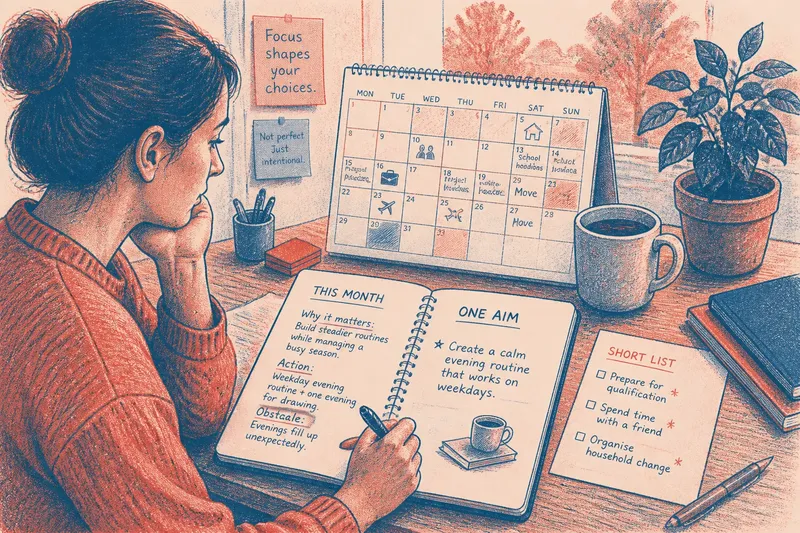
A First Month After Your Role Changes
A first month after your role changes can help you notice which routines and expectations still fit, without forcing a new identity before you are ready.

What should you do in the first month after your role changes? Give yourself room to notice what has shifted before deciding what the change means about who you are. A new job, a move into caring for someone, becoming a parent, stepping away from a group, or taking on a different place in a team can unsettle ordinary routines as well as expectations. You do not need a polished account of your new identity by the end of the month.
Instead, treat these first weeks as a period of observation. Some familiar habits may still be useful; others may belong to a role you no longer hold. A gentle reflection practice can help you tell the difference without turning every uncertain feeling into a problem to solve.
What is the first month for?
Use it to gather small, everyday clues about what feels workable now. You are not trying to make a permanent plan or judge whether the change was right. You are learning how the new role meets the shape of your actual days.
That distinction matters because a role change often arrives with a story attached: you should feel more confident, more fulfilled, more available, or immediately certain. Those expectations can make ordinary adjustment feel like failure. In practice, a day may include both relief and irritation, or a moment of pride followed by a longing for an old routine. Mixed reactions are information, not a verdict.
Pick a low-effort place to notice them. A few lines in a notebook, a note on your phone, or a quiet pause on the walk home can be enough. Write down what happened, what you expected, and what you would like to remember. Keep the record private if that makes it easier to be candid.
Which routines should I keep?
Keep routines that still support your needs and fit the conditions of your changed role. A habit is not automatically useful just because it worked before, and it is not automatically obsolete because your circumstances have changed.
Look at the ordinary anchors of your day: how you begin the morning, when you eat, how you handle messages, what helps you switch off, and whom you see regularly. Ask whether each one still serves a purpose. Perhaps a morning walk gives you steadiness regardless of your job title; perhaps checking messages before breakfast now makes you feel on call long before the day begins.
Try to notice the difference between a routine and the expectation attached to it. You might value a regular conversation with a friend, while the old assumption that it must happen on a particular evening no longer works. The connection can remain even if its timing changes.
Imagine you have moved from a shared office to working from home. You notice that a short walk before opening your laptop helps mark the start of the day, while checking work messages late at night leaves you restless. You might keep the walk and experiment with a clearer stopping point, then observe whether your evenings feel less occupied by work. That is a modest adjustment, not a declaration about your whole future.
Keep what helps; loosen what only survives through guilt.
How can I tell which expectations still fit?
Ask whether an expectation reflects your present responsibilities and priorities, or whether you are carrying it forward simply because someone once relied on it. Some expectations are shared agreements that need a conversation; others are silent rules you may have set for yourself.
Notice the language in your mind. “I should reply straight away,” “I must be the dependable one,” or “I ought to enjoy every part of this” can point to an assumption worth examining. Do not rush to reject it. First ask what it protects, who it affects, and whether there is a more realistic way to meet the underlying need.
If an expectation involves another person, make space for their perspective rather than silently changing the arrangement. A calm, specific conversation is often more useful than trying to infer what everyone wants. You could say, “My schedule has changed, so I can no longer take this on each week. Can we talk about another arrangement?”
For expectations tied to formal duties, workplace policies, care arrangements, or other commitments, check the relevant agreement and speak with the appropriate person when needed. Where a question depends on a label, manufacturer instructions, or local rules, follow the applicable guidance rather than relying on a general reflection exercise.
What should I do when I miss my old role?
Let yourself name what you miss without treating that feeling as proof that the change was a mistake. You may miss the people, a familiar rhythm, the authority to make certain decisions, or the feeling of being needed. Naming the specific loss can show you what matters, even if the old arrangement cannot return.
It can help to separate the role from the need it met. If you miss being part of a team, could you build connection in a way that fits your current life? If you miss making things, is there a small place for that activity outside the former role? The answer may be yes, no, or not yet; any of those is a valid observation.
There is no need to replace every lost part straight away. A quiet gap can be uncomfortable, but filling it immediately with commitments may hide what you actually want. Let the feeling have a little room before making a new promise.
How do I reflect without turning it into a scorecard?
Use neutral questions that invite description rather than a grade. For a few moments at the end of a day or week, you might ask:
- What felt easier than I expected?
- What took more effort than it used to?
- When did I feel most like myself, without needing to define that phrase?
- Which request or task did I accept automatically?
- What would I like to try differently once, rather than promise forever?
There is no need to answer every question every time. Choose one that catches your attention, and keep your reply brief. If a question leaves you feeling accused, reword it. “Why can’t I manage this?” can become “What made this difficult today?” The change in wording shifts attention from blame to conditions you can actually observe.
Avoid turning the notes into a record of whether you are adapting quickly enough. A reflective note is useful when it helps you see a pattern or make a considerate choice. It need not end with an action item. Sometimes the useful thing is simply recognising that a particular afternoon was draining.
What if the change still feels unsettled?
Give uncertainty time, and distinguish ordinary unfamiliarity from a problem that needs practical attention. You may still be learning who to ask for help, how to organise your day, or what your new responsibilities include. Those questions can become clearer through conversations and experience rather than introspection alone.
If you feel overwhelmed, look for one small source of support: a trusted colleague, a friend, a family member, a supervisor, or a qualified professional, depending on the situation. You can ask for a clearer expectation, a temporary adjustment, or simply a chance to talk through what has changed. Seeking support does not mean you have failed to adapt.
Some changes also involve grief, conflict, financial pressure, or significant strain on your wellbeing. General reflection is not a substitute for specialist advice when the situation calls for it. If the weight feels difficult to manage, consider speaking with a suitable professional or support service.
What questions are worth asking as the month closes?
Do I need to decide who I am now?
No. A role describes one part of your life, not the whole of you, and a month of observation cannot be expected to settle every question. You can make the next small decision without giving it a permanent identity label.
Should I keep every old routine that feels comforting?
Not necessarily; comfort can be a useful clue, but a routine also needs to fit your current time and responsibilities. Keep the parts that support you and revisit those that create strain or no longer serve a clear purpose.
What if other people expect me to settle quickly?
You can acknowledge their expectations without making them your timetable. If their expectations affect shared work or care, discuss what is realistic and agree on a workable arrangement rather than relying on hints.
What is a useful next step after the first month?
Choose one observation to carry forward and one routine or expectation to review. You might keep a helpful morning pause, ask for clarity about a recurring responsibility, or leave a decision open until you have more information.
How can I carry the reflection forward?
At the end of the month, read your notes once and look for recurring details, not a grand verdict. What repeatedly gave you energy? What kept colliding with the shape of your day? Which expectation did you discover you had never actually agreed to? These observations can inform a small next choice.
Keep that choice modest and revisable. You might protect an uninterrupted lunch, ask for a clearer handover, or arrange a regular conversation with someone whose company you miss. State what you will try, then give yourself permission to adjust it if circumstances change.
The first month after your role changes is useful not because it produces a finished identity, but because it lets you meet your new days with attention. Keep the notes that help you see clearly, leave open questions open, and let your next direction grow from what you learn about the life you are actually living.