The Plan That Leaves No Room for a Changed Week
A flexible weekly plan helps you respond to disruptions, choose what still deserves attention and avoid turning one changed appointment into a diary reshuffle.
What should you keep when a carefully planned week changes by Tuesday? A flexible weekly plan helps you decide what to do next without treating every missed slot as a reason to rearrange the whole diary. If an appointment runs late, a family member needs help or your energy drops, the useful question is not how to restore the original timetable. It is which decision needs making now.
That decision may be to shrink a task, move it, ask someone for help or let it go. A plan works best as a record of those choices, not as a promise that every day will unfold as expected.
A changed week calls for a decision, not a diary rebuild
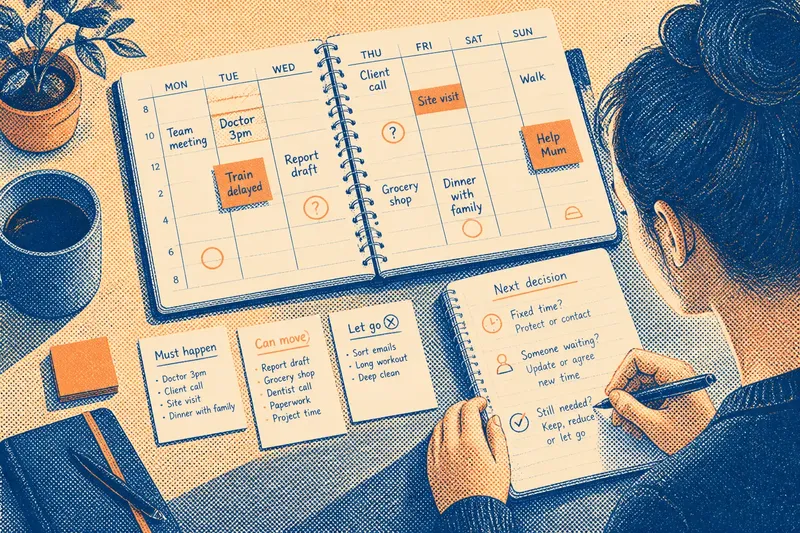
When plans shift, it is easy to spend your available attention moving boxes around a calendar. Before rescheduling anything, sort the affected items into three groups: commitments that still need to happen, tasks that can move, and tasks that no longer deserve space this week.
Keep the first group visible, but do not automatically preserve the rest. A task that mattered when you wrote it down may have been overtaken by new information. Deciding that it can wait—or no longer belongs—can be more useful than finding it another slot.
Try a quick pass through the diary: mark fixed appointments, circle tasks that need a decision from someone else, and leave movable tasks in a separate list. You only need to reopen the calendar for items with a real timing constraint.
Choose the smallest action that still moves things forward
A missed task does not always need to be repeated in full. Ask what visible progress would count for now. If an evening set aside for a personal project disappears, opening the document and writing down the next question may be enough to make a later start clearer.
Say you planned to sort a folder of paperwork after work, but a delayed train leaves you tired and short on time. The starting point is a folder you have not opened; the action is to place it on the table and mark the form that needs a reply. The result is a clear next item, while the remaining papers stay for a day when you can give them proper attention.
Keep the reduced action genuinely small. If it requires the same preparation and concentration as the original task, it may not be a useful adjustment.
Leave space for the parts of a week you cannot schedule
A diary can look spacious while hiding the time needed to travel, eat, recover or deal with a routine delay. Filling every gap makes ordinary changes feel like emergencies. Look for commitments that depend on everything going smoothly, then decide in advance what could be shortened or postponed if the day runs long.
For example, you might protect a meeting that affects another person, while keeping a household task movable. If the meeting overruns, the task can move without forcing you to shift every later appointment. The useful distinction is not between important and unimportant activities; it is between what has a real constraint and what has room to change.
Keep one unassigned opening if your week allows it. It is available capacity, not a forgotten task.
Match the task to the attention you have available
A free hour does not automatically suit every kind of work. Focused writing, a phone call and sorting receipts ask for different kinds of attention. When your energy does not match the planned task, choose whether to make the task lighter or use the opening for something that fits better.
Imagine you planned to complete a complicated form after a demanding day. You have the form, the relevant letters and little concentration left. Instead of forcing the whole job, you could gather the papers and write down the question you need to ask; the result is a prepared starting point, not a completed form. If even that feels too much, leave the form untouched and choose a calmer time rather than creating avoidable errors.
If a task involves legal, financial or health decisions, use general planning to organise your questions and documents, then speak with a suitably qualified professional where needed.
Keep flexible tasks visible without assigning them a new slot
Repeated rescheduling can become its own chore. Separate fixed appointments from movable tasks, and keep the latter on a short list with clear next actions. When an opening appears, choose an item that fits the time, your attention and any deadline.
Say you planned to call the dentist during lunch, but a colleague asks for help. If the call has no immediate deadline, leave it on the flexible list and choose another suitable opening; if the practice needs an answer that day, find a later time or ask whether someone can call on your behalf. Either way, you change the affected task rather than rebuilding the entire diary.
What should change when the same task keeps slipping?
Should you move every unfinished task into next week?
No. Check whether each task still matters and whether it has a genuine deadline. If it does, choose a workable time or ask for help; if it does not, reduce it, defer it deliberately or remove it from the list.
What if a task slips more than once?
Check whether the task is too large, poorly timed or dependent on something you do not control. If the next action is unclear, define one; if the timing repeatedly fails, choose a different opening or reconsider whether the task belongs in your week.
How detailed should a weekly plan be?
Give appointments that involve other people or fixed times their actual place in the diary. If a task can happen at several points, write a specific next action on a separate list; add a time only when coordination or a real deadline requires it.
When should you let an intention go?
Check whether its original reason still applies. If the situation has changed, remove or revise the task; if the reason remains but the current version is impractical, choose a smaller action or a more suitable time.
Use a short decision list when the week changes
When a disruption arrives, it helps to make the next decision explicit rather than trying to rescue every plan. Check each affected item and choose an action based on what you observe:
- Check whether the item has a fixed appointment or deadline. If it does, protect that timing or contact the people involved; if it does not, keep it movable.
- Check whether someone else is waiting for your response. If they are, send a brief update or agree a new time; if they are not, decide later without disturbing other commitments.
- Check whether the task still serves a current need. If it does, keep it or reduce its scope; if it does not, remove it from this week’s list.
- Check whether you have the materials needed to begin. If you do, choose a suitable opening; if you do not, add a preparation action or ask for the missing information.
- Check whether the available time suits the task’s attention demands. If it does, use that opening; if it does not, switch to a lighter task or leave the work for a better time.
- Check whether moving the task would displace another fixed commitment. If it would, choose a different opening or let the task wait; if it would not, move only that task.
- Check whether a smaller action would leave a clear next step. If it would, do that action; if it would not, pause and decide what preparation or support is needed.
For instance, imagine your starting list has a fixed school meeting, a call to the dentist and a draft you hoped to write. The meeting runs late, and you have a short evening left. Keep the meeting as completed; check whether the dentist call has a same-day deadline, and, if it does, call or request help, but otherwise leave it on the flexible list. For the draft, write one note naming the next section rather than attempting the full session. The resulting plan preserves the fixed commitment, handles any urgent call and gives the writing a clear next start, without shifting every other task.
Make the next weekly plan easier to adjust
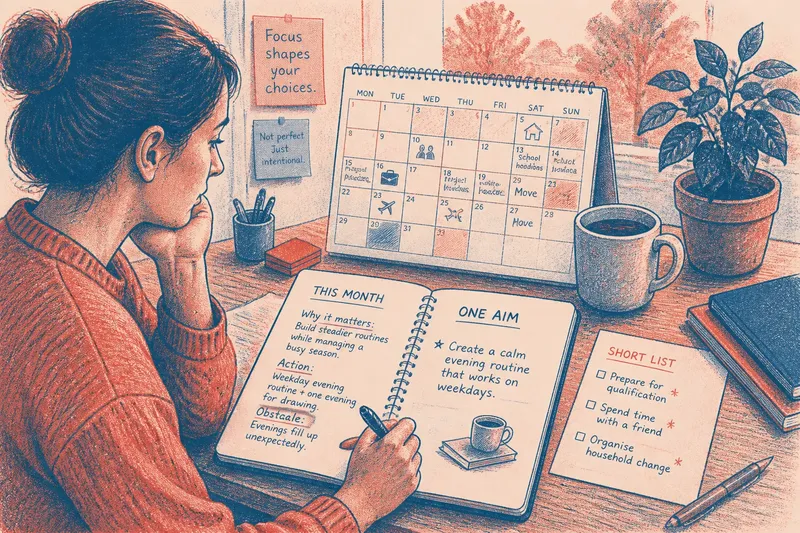
When you make a flexible weekly plan, note the next action beside each priority and mark which items have real timing constraints. Keep movable tasks together, and leave room for travel, rest or the ordinary surprises that interrupt a day. If the week changes, decide item by item whether to keep, reduce, move or drop the affected task.
Near the end of the week, notice which task was hardest to place and what made it difficult: unclear next action, unsuitable timing, missing information or a change in circumstances. That observation gives you a specific adjustment for the next plan, such as preparing materials earlier or leaving a task off until its timing becomes clearer.